


 Email this article


Coding Learning Approaches for Early Childhood: A Systematic Review
Abstract
Full Text:
PDFReferences
Arthur, L., Beecher, B., Death, E., Dockett, S., & Farmer, S. (2017). Programming and planning in early childhood settings. Cengage AU. https://books.google.com/books?
hl=en&lr=&id=zkNMDwAAQBAJ&oi=fnd&pg=PR1&dq=ensuring+children+have+experience+in+programming+in+early+childhood+education&ots=L1HrWccWdU&sig=ratUYf5irVN873toJaP6CPAQrY4
Barr, D., Harrison, J., & Conery, L. (2011). Computational thinking: A digital age skill for everyone. Learning & Leading with Technology, 38(6), 20–23.
Bers, M. U. (2018). Coding and computational thinking in early childhood: The impact of ScratchJr in Europe. European Journal of STEM Education, 3(3), 8.
Bers, M. U. (2020). Coding as a playground: Programming and computational thinking in the early childhood classroom. Routledge. https://www.taylorfrancis.com/books/mono/10.4324/9781003022602/coding-playground-marina-umaschi-bers
Blake-West, J. C., & Bers, M. U. (2023). ScratchJr design in practice: Low floor, high ceiling. International Journal of Child-Computer Interaction, 37, 100601. https://doi.org/10.1016/j.ijcci.2023.100601
Canbeldek, M., & Isikoglu, N. (2023). Exploring the effects of “productive children: Coding and robotics education program” in early childhood education. Education and Information Technologies, 28(3), 3359–3379. https://doi.org/10.1007/s10639-022-11315-x
Critten, V., Hagon, H., & Messer, D. (2022). Can Pre-school Children Learn Programming and Coding Through Guided Play Activities? A Case Study in Computational Thinking. Early Childhood Education Journal, 50(6), 969–981. https://doi.org/10.1007/s10643-021-01236-8
Davis, J., Mengersen, K., Bennett, S., & Mazerolle, L. (2014). Viewing systematic reviews and meta-analysis in social research through different lenses. SpringerPlus, 3(1), 511. https://doi.org/10.1186/2193-1801-3-511
Demir, B. E., & Demir, F. (2021). Coding, Robotics and Computational Thinking in Preschool Education: The Design of Magne-Board. Avrupa Bilim ve Teknoloji Dergisi, 23, Article 23. https://doi.org/10.31590/ejosat.842483
Gerosa, A., Koleszar, V., Tejera, G., Gómez-Sena, L., & Carboni, A. (2022). Educational Robotics Intervention to Foster Computational Thinking in Preschoolers: Effects of Children’s Task Engagement. Frontiers in Psychology, 13. https://doi.org/10.3389/fpsyg.2022.904761
Grover, S. (2017). Assessing algorithmic and computational thinking in K-12: Lessons from a middle school classroom. Dalam Emerging research, practice, and policy on computational thinking (hlm. 269–288). Springer.
Grover, S., & Pea, R. (2013). Computational thinking in K–12: A review of the state of the field. Educational researcher, 42(1), 38–43.
Kazakoff, E., & Bers, M. (2012). Programming in a robotics context in the kindergarten classroom: The impact on sequencing skills. Journal of Educational Multimedia and Hypermedia, 21(4), 371–391.
Kitchenham, B., Pretorius, R., Budgen, D., Brereton, O. P., Turner, M., Niazi, M., & Linkman, S. (2010). Systematic literature reviews in software engineering–a tertiary study. Information and software technology, 52(8), 792–805.
Kotsopoulos, D., Floyd, L., Dickson, B. A., Nelson, V., & Makosz, S. (2022). Noticing and Naming Computational Thinking During Play. Early Childhood Education Journal, 50(4), 699–708. https://doi.org/10.1007/s10643-021-01188-z
Lavigne, H. J., Lewis-Presser, A., & Rosenfeld, D. (2020). An exploratory approach for investigating the integration of computational thinking and mathematics for preschool children. Journal of Digital Learning in Teacher Education, 36(1), 63–77. https://doi.org/10.1080/21532974.2019.1693940
Lee, T. Y., Mauriello, M. L., Ahn, J., & Bederson, B. B. (2014). CTArcade: Computational thinking with games in school age children. International Journal of Child-Computer Interaction, 2(1), 26–33. https://doi.org/10.1016/j.ijcci.2014.06.003
Li, W., Duncan, G. J., Magnuson, K., Schindler, H. S., Yoshikawa, H., & Leak, J. (2020). Timing in Early Childhood Education: How Cognitive and Achievement Program Impacts Vary by Starting Age, Program Duration, and Time since the End of the Program. EdWorkingPaper No. 20-201. Annenberg Institute for School Reform at Brown University. https://eric.ed.gov/?id=ED610271
Lin, S.-Y., Chien, S.-Y., Hsiao, C.-L., Hsia, C.-H., & Chao, K.-M. (2020). Enhancing Computational Thinking Capability of Preschool Children by Game-based Smart Toys. Electronic Commerce Research and Applications, 44, 101011. https://doi.org/10.1016/j.elerap.2020.101011
Misirli, A., & Komis, V. (2023). Computational thinking in early childhood education: The impact of programming a tangible robot on developing debugging knowledge. Early Childhood Research Quarterly, 65, 139–158.
Papadakis, S. (2022). Apps to Promote Computational Thinking and Coding Skills to Young Age Children: A Pedagogical Challenge for the 21st Century Learners. Educational Process: International Journal (EDUPIJ), 11(1), 7–13.
Pérez-Marín, D., Hijón-Neira, R., Bacelo, A., & Pizarro, C. (2020a). Can computational thinking be improved by using a methodology based on metaphors and scratch to teach computer programming to children? Computers in Human Behavior, 105, 105849.
Pérez-Marín, D., Hijón-Neira, R., Bacelo, A., & Pizarro, C. (2020b). Can computational thinking be improved by using a methodology based on metaphors and scratch to teach computer programming to children? Computers in Human Behavior, 105, 105849. https://doi.org/10.1016/j.chb.2018.12.027
Piaget, J. (1962). The stages of the intellectual development of the child. Bulletin of the Menninger clinic, 26(3), 120.
Piaget, J. (2013). Play, dreams and imitation in childhood (Vol. 25). Routledge.
Ploog, M., & Wiktorski, T. (2024). The intentions of the designers of digital educational tools in early childhood education. International Journal of Child-Computer Interaction, 40, 100653. https://doi.org/10.1016/j.ijcci.2024.100653
Relkin, E., de Ruiter, L. E., & Bers, M. U. (2021). Learning to code and the acquisition of computational thinking by young children. Computers & education, 169, 104222.
Saxena, A., Lo, C. K., Hew, K. F., & Wong, G. K. W. (2020). Designing Unplugged and Plugged Activities to Cultivate Computational Thinking: An Exploratory Study in Early Childhood Education. The Asia-Pacific Education Researcher, 29(1), 55–66. https://doi.org/10.1007/s40299-019-00478-w
Shonkoff, J. P., Duncan, G. J., Fisher, P. A., Magnuson, K., & Raver, C. (2011). Building the brain’s “air traffic control” system: How early experiences shape the development of executive function. Contract, 11.
Su, J., & Yang, W. (2023). A systematic review of integrating computational thinking in early childhood education. Computers and Education Open, 4, 100122. https://doi.org/10.1016/j.caeo.2023.100122
Turan, S., & Aydoğdu, F. (2020). Effect of coding and robotic education on pre-school children’s skills of scientific process. Education and Information Technologies, 25(5), 4353–4363.
https://doi.org/10.1007/s10639-020-10178-4
Van Keulen, H. (2018). STEM in early childhood education. European Journal of STEM Education, 3(3), 06.
Wang, D., Wang, T., & Liu, Z. (2014). A tangible programming tool for children to cultivate computational thinking. The Scientific World Journal, 2014.
Watts, T. W., Gandhi, J., Ibrahim, D. A., Masucci, M. D., & Raver, C. C. (2018). The Chicago School Readiness Project: Examining the long-term impacts of an early childhood intervention. PloS one, 13(7), e0200144.
Weipeng Yang, Ng, D. T. K., & Gao, H. (2022). Robot programming versus block play in early childhood education: Effects on computational thinking, sequencing ability, and self-regulation. British Journal of Educational Technology, 53(6), 1817–1841. https://doi.org/10.1111/bjet.13215
Wing, J. M. (2008). Computational thinking and thinking about computing. Philosophical Transactions of the Royal Society A: Mathematical, Physical and Engineering Sciences, 366(1881), 3717–3725.
Yadav, A., Hong, H., & Stephenson, C. (2016). Computational thinking for all: Pedagogical approaches to embedding 21st century problem solving in K-12 classrooms. TechTrends, 60(6), 565–568.
Yang, W., Ng, D. T. K., & Gao, H. (2022). Robot programming versus block play in early childhood education: Effects on computational thinking, sequencing ability, and self-regulation. British Journal of Educational Technology, 53(6), 1817–1841. https://doi.org/10.1111/bjet.13215
Zurnacı, B., & Turan, Z. (2024). Educational robotics or unplugged coding activities in kindergartens?: Comparison of the effects on pre-school children’s computational thinking and executive function skills. Thinking Skills and Creativity, 53, 101576.
Refbacks
- There are currently no refbacks.
Copyright (c) 2025 Bayu Widyaswara Suwahyo

This work is licensed under a Creative Commons Attribution-ShareAlike 4.0 International License.
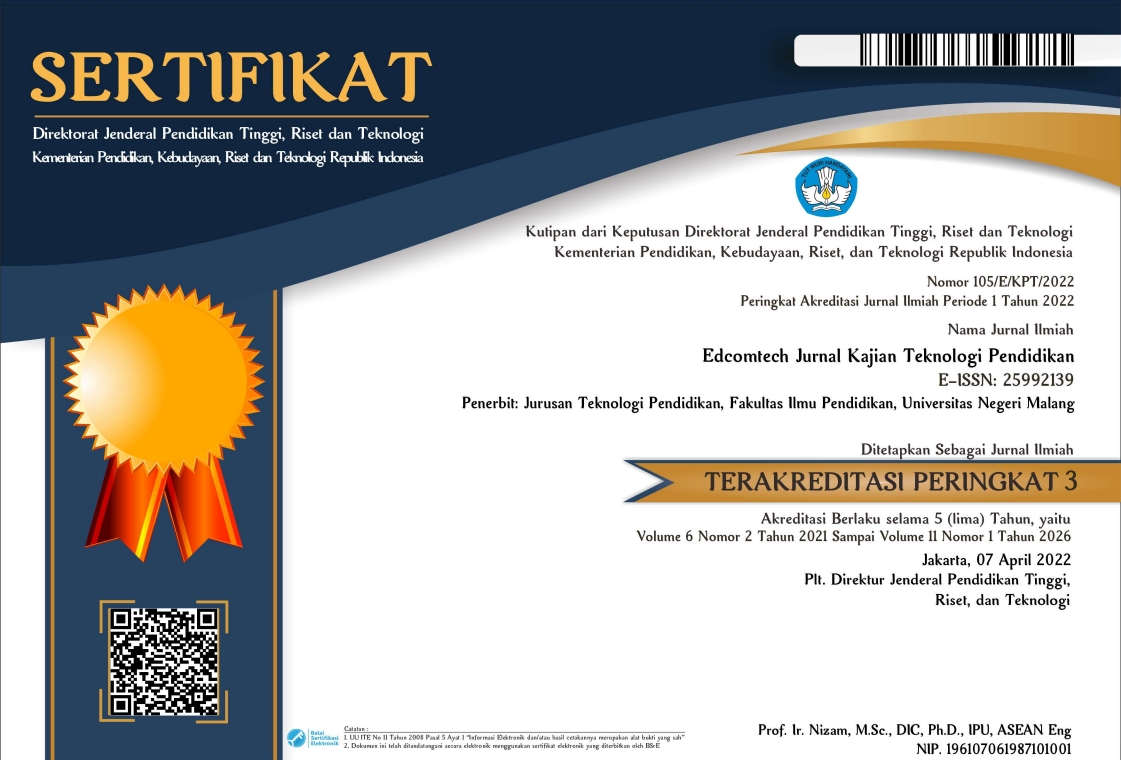
Edcomtech: Jurnal Kajian Teknologi Pendidikan published by Department of Educational Technology, Faculty of Education, State University of Malang in Collaboration with Asosiasi Program Studi Teknologi Pendidikan Indonesia (APS TPI) and Ikatan Profesi Teknologi Pendidikan Indonesia (IPTPI) with MoU.
Publisher Address:
Lab. Teknologi Pendidikan, Gd.E2, Lt.1
Fakultas Ilmu Pendidikan Universitas Negeri Malang
Jalan Semarang No 5, Kota Malang Kode Pos 65145
Email: [email protected]
========================================================================================================
| INDEXED BY | TOOLS | PLAGIARISM CHECK | ARTICLE TEMPLATE |
|
|
|
|







1.png)











Edcomtech is licensed under a Creative Commons Attribution-ShareAlike 4.0 International License.
Edcomtech Statistics (Since July 13th, 2020)