









 Email this article












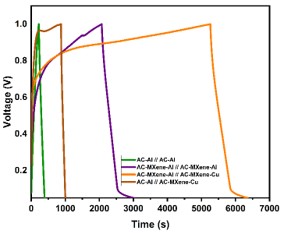
Comprehensive Investigation of MXene and Cassava Tubers-Bamboo Stems Activated Carbon Electrodes: Configuration-Dependent Supercapacitor Performances
Abstract
Keywords
Full Text:
PDFReferences
K. Liu et al., “Flexible electrode materials for emerging electronics: materials, fabrication and applications,” J. Mater. Chem. A, vol. 12, no. 32, pp. 20606–20637, 2024, doi: 10.1039/D4TA01960A.
Z. Dong et al., “A Survey of Battery–Supercapacitor Hybrid Energy Storage Systems: Concept, Topology, Control and Application,” Symmetry (Basel)., vol. 14, no. 6, p. 1085, May 2022, doi: 10.3390/sym14061085.
M. Diantoro et al., “3D-porous activated carbon morphological modification of Manihot esculenta tuber and Bambusa blumeana stem for high-power density supercapacitor: Biomass waste to sustainable energy,” Carbon Resour. Convers., p. 100313, Mar. 2025, doi: 10.1016/j.crcon.2025.100313.
H. Rustamaji et al., “Synthesis of rubber seed shell-derived porous activated carbons for promising supercapacitor application,” Int. J. Renew. Energy Dev., vol. 14, no. 2, pp. 265–275, Mar. 2025, doi: 10.61435/ijred.2025.60869.
R. Chen, M. Yu, R. P. Sahu, I. K. Puri, and I. Zhitomirsky, “The Development of Pseudocapacitor Electrodes and Devices with High Active Mass Loading,” Adv. Energy Mater., vol. 10, no. 20, May 2020, doi: 10.1002/aenm.201903848.
N. Wu et al., “Recent Advances of Asymmetric Supercapacitors,” Adv. Mater. Interfaces, vol. 8, no. 1, Jan. 2021, doi: 10.1002/admi.202001710.
K. Khan et al., “Recent Advances in Non‐Ti MXenes: Synthesis, Properties, and Novel Applications,” Adv. Sci., vol. 11, no. 36, Sep. 2024, doi: 10.1002/advs.202303998.
L. Ma, T. Zhao, F. Xu, T. You, and X. Zhang, “A dual utilization strategy of lignosulfonate for MXene asymmetric supercapacitor with high area energy density,” Chem. Eng. J., vol. 405, p. 126694, Feb. 2021, doi: 10.1016/j.cej.2020.126694.
S. De, C. K. Maity, S. Sahoo, and G. C. Nayak, “Polyindole Booster for Ti 3 C 2 T x MXene Based Symmetric and Asymmetric Supercapacitor Devices,” ACS Appl. Energy Mater., vol. 4, no. 4, pp. 3712–3723, Apr. 2021, doi: 10.1021/acsaem.1c00142.
Z. Pan and X. Ji, “Facile synthesis of nitrogen and oxygen co-doped C@Ti3C2 MXene for high performance symmetric supercapacitors,” J. Power Sources, vol. 439, p. 227068, Nov. 2019, doi: 10.1016/j.jpowsour.2019.227068.
H. Liu et al., “A facile method for synthesizing NiS nanoflower grown on MXene (Ti3C2Tx) as positive electrodes for ‘supercapattery,’” Electrochim. Acta, vol. 353, p. 136526, Sep. 2020, doi: 10.1016/j.electacta.2020.136526.
Y. Tian, C. Yang, Y. Tang, Y. Luo, X. Lou, and W. Que, “Ti3C2T //AC dual-ions hybrid aqueous supercapacitors with high volumetric energy density,” Chem. Eng. J., vol. 393, p. 124790, Aug. 2020, doi: 10.1016/j.cej.2020.124790.
V. Thirumal, P. Rajkumar, B. Babu, J.-H. Kim, and K. Yoo, “Performance of asymmetric hybrid supercapacitor device based on antimony-titanium carbide MXene composite,” J. Alloys Compd., vol. 982, p. 173598, Apr. 2024, doi: 10.1016/j.jallcom.2024.173598.
W. Chen et al., “V2CTx MXene as novel anode for aqueous asymmetric supercapacitor with superb durability in ZnSO4 electrolyte,” J. Colloid Interface Sci., vol. 626, pp. 59–67, Nov. 2022, doi: 10.1016/j.jcis.2022.06.142.
S. Rafiq et al., “Novel room-temperature ferromagnetism in Gd-doped 2-dimensional Ti3C2Tx MXene semiconductor for spintronics,” J. Magn. Magn. Mater., vol. 497, p. 165954, Mar. 2020, doi: 10.1016/j.jmmm.2019.165954.
C. R. Babu, A. V. Avani, T. S. Xavier, M. Tomy, S. Shaji, and E. I. Anila, “Symmetric supercapacitor based on Co3O4 nanoparticles with an improved specific capacitance and energy density,” J. Energy Storage, vol. 80, p. 110382, Mar. 2024, doi: 10.1016/j.est.2023.110382.
B. J. Choudhury, H. H. Muigai, P. Kalita, and V. S. Moholkar, “Biomass blend derived porous carbon for aqueous supercapacitors with commercial-level mass loadings and enhanced energy density in redox-active electrolyte,” Appl. Surf. Sci., vol. 601, p. 154202, Nov. 2022, doi: 10.1016/j.apsusc.2022.154202.
Y. Wen et al., “Nitrogen-doped Ti3C2T x MXene electrodes for high-performance supercapacitors,” Nano Energy, vol. 38, pp. 368–376, Aug. 2017, doi: 10.1016/j.nanoen.2017.06.009.
H. Zhang et al., “Gradient-Layered MXene/Hollow Lignin Nanospheres Architecture Design for Flexible and Stretchable Supercapacitors,” Nano-Micro Lett., vol. 17, no. 1, p. 43, Dec. 2025, doi: 10.1007/s40820-024-01512-3.
L. Pradhan et al., “Supercapacitor properties of partially oxidised-MXene quantum dots/graphene hybrids: Fabrication of flexible/wearable micro-supercapacitor devices,” Chem. Eng. J., vol. 497, p. 154587, Oct. 2024, doi: 10.1016/j.cej.2024.154587.
P. Merin, P. Jimmy Joy, M. N. Muralidharan, E. Veena Gopalan, and A. Seema, “Biomass‐Derived Activated Carbon for High‐Performance Supercapacitor Electrode Applications,” Chem. Eng. Technol., vol. 44, no. 5, pp. 844–851, May 2021, doi: 10.1002/ceat.202000450.
L. Yu et al., “MXene-Bonded Activated Carbon as a Flexible Electrode for High-Performance Supercapacitors,” ACS Energy Lett., vol. 3, no. 7, pp. 1597–1603, Jul. 2018, doi: 10.1021/acsenergylett.8b00718.
Z. He et al., “Pseudocapacitance of Bimetallic Solid‐Solution MXene for Supercapacitors with Enhanced Electrochemical Energy Storage,” Adv. Funct. Mater., vol. 33, no. 52, Dec. 2023, doi: 10.1002/adfm.202305251.
S. Myeong, S. Ha, C. Lim, C. G. Min, and Y.-S. Lee, “Effect of fluorine functional groups introduced into activated carbon aerogel by carbon tetrafluoride plasmas in supercapacitors,” Carbon Lett., vol. 34, no. 1, pp. 65–74, Jan. 2024, doi: 10.1007/s42823-023-00668-z.
Copyright (c) 2024 Nuviya Illa Muthi Aturroifah, Markus Diantoro, Nasikhudin Nasikhudin

This work is licensed under a Creative Commons Attribution-ShareAlike 4.0 International License.

This work is licensed under a Creative Commons Attribution-ShareAlike 4.0 International License